

Domande e risposteQuestions & answers
Questions, answered
23 answers about handmade violins, violas, cellos and double basses — the instruments, commissions and prices, sizes and care, the craft and the maker.
Gli strumenti
The instruments
01 What instruments does Gregorio Martini make?
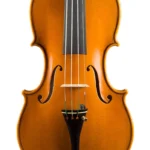
Gregorio Martini makes the four voices of the violin family entirely by hand: violins, violas, cellos and double basses. Each instrument is built individually, from the choice of tonewood to the final set-up.
02 What is the difference between a handmade and a factory violin?
A handmade violin is carved by one maker, who graduates the thickness of each plate by hand and by ear to suit that particular piece of wood. A factory instrument is shaped to fixed measurements. The result of handwork is an instrument that responds more freely and has a voice of its own.
03 Which woods are used for a handmade violin?
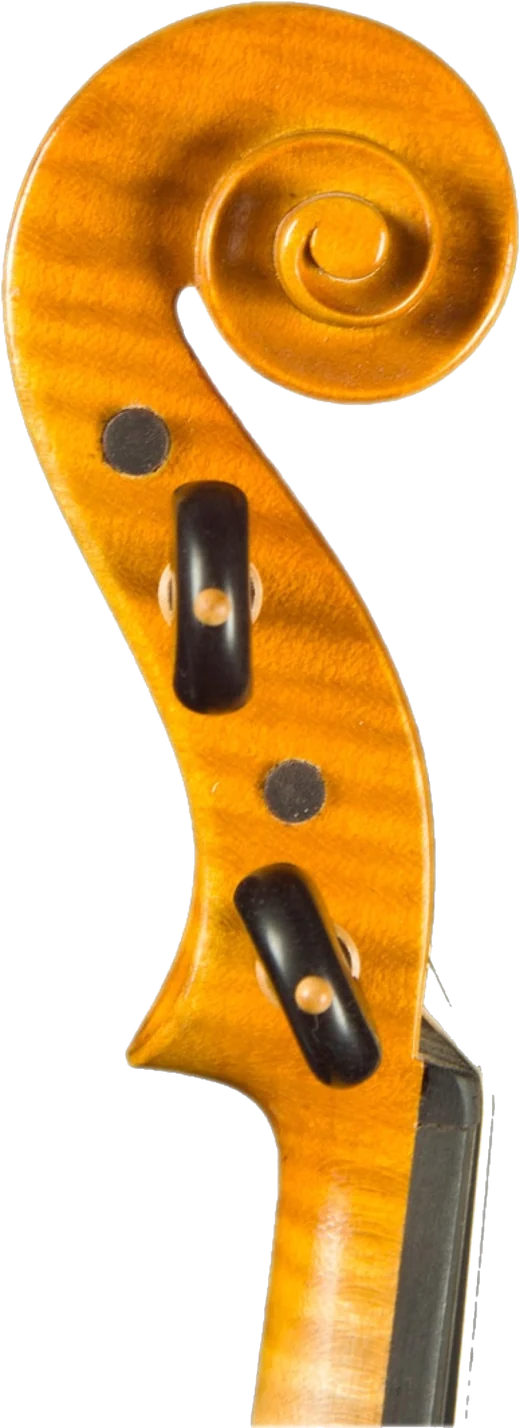
Following the classical tradition, the top is carved from spruce, while the back, ribs and scroll are carved from maple — often flamed maple, whose figure shimmers under the varnish. The fingerboard and fittings are usually ebony.
04 How is a viola different from a violin?
The viola is larger and tuned a fifth lower, to C, G, D and A. It reads mostly in the alto clef and has a darker, warmer, more veiled voice that binds the harmony of the string quartet and the orchestra.
05 Why is the cello said to be closest to the human voice?
Its range, from a deep bass to a singing upper register, covers much of the range of the human voice, and its tone is warm and expressive — which is why the comparison is so often made.
06 How is the double bass tuned?
Unlike the violin, viola and cello, which are tuned in fifths, the double bass is usually tuned in fourths: E, A, D and G.
07 Is the double bass played with a bow or plucked?
Both. It is played with the bow (arco) in orchestral and chamber music and plucked (pizzicato) above all in jazz — a handmade bass is built to speak clearly in both.
Su misura
Commissions & prices
08 Can I commission a made-to-measure instrument?
Yes. A commission begins with a conversation about your playing, your repertoire and the sound you are looking for. Together you choose the model, the wood and the colour of the varnish, and the instrument is then made for you alone.
09 How can I find out the price of an instrument?
Each instrument is unique, so prices are given on request. Send the opus number of the instrument you are interested in to mgviolinmaker@gmail.com and you will receive full details, additional photographs and the price.
10 How long does it take to make a violin by hand?
Building a violin by hand takes many weeks of bench work, followed by the slow layering and curing of the varnish. The timing for each commission is agreed at the very first conversation.
11 What should I write in my first message?
Tell Gregorio a little about yourself as a player: your instrument, your repertoire, the sound you are looking for and, if you have one, the instrument from the catalogue that interests you. That is all a first conversation needs.
12 Can a viola be made to measure?
Yes. A commissioned viola can be built to the size, model and colour that suit you, after a conversation about your playing and the sound you are looking for.
Il liutaio
The maker
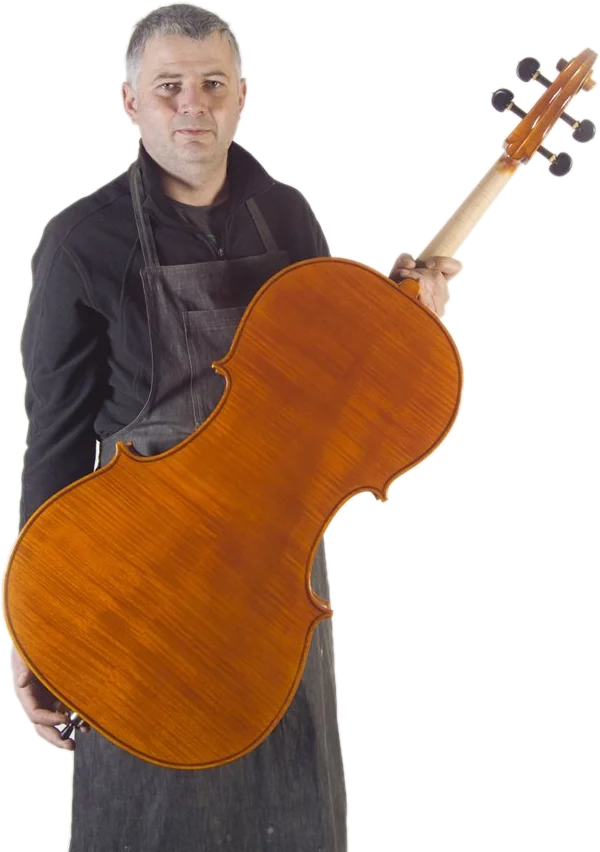
13 Who is Gregorio Martini?
Gregorio Martini is a luthier — a maker of string instruments — who builds violins, violas, cellos and double basses entirely by hand. He trained for six years in Cremona and spent a year in the atelier of Riccardo Bergonzi.
14 Where did Gregorio Martini train as a violin maker?
He spent six years in the advanced violin-making course of the Istituto Professionale Internazionale per l’Artigianato Liutario e del Legno “Antonio Stradivari” (I.P.I.A.L.L.) in Cremona, Italy, under master Aromatico, followed by a one-year internship in the atelier of Riccardo Bergonzi. His contact with Alessandro Ciciliati of the Ferrara school had a lasting influence on his style.
15 Has Gregorio Martini exhibited his instruments?
Yes. He presented his instruments at Cremona Mondomusica, the international exhibition of fine string instruments, in 2012 and 2013.
Misure e cura
Sizes & care
16 What size violin does an adult play?
Most adults play a full-size (4/4) violin, with a body length of about 35.5 cm. Smaller fractional sizes exist for children; the right size depends on arm length and comfort.
17 What size viola should I choose?
Violas are measured by body length — from about 38 cm up to 45.5 cm for the largest models. The right size balances depth of sound with comfort under the hand, so it is chosen around the player: arm length, hand span and the voice you are looking for.
18 What size cello does an adult play?
Adults usually play a full-size (4/4) cello, with a body length of about 75–76 cm. Smaller sizes are made for younger players.
19 What size double bass do most players use?
The ¾ size is the most common for adult players. Full-size (4/4) basses exist but are less usual; the choice depends on height, hand span and the music played.
20 How should a handmade violin be cared for?
Keep it in its case, away from heat and sudden changes of humidity (ideally 40–60 %). Wipe rosin from the strings and top after playing, and have the bridge, soundpost and strings checked by a luthier regularly.
21 How should a cello be cared for?
Keep it in its case, away from heat and humidity changes, retract the endpin when it is not played, and have the set-up checked by a luthier at least once a year.
Il mestiere
The craft
22 What is graduation in violin making?
Graduation is the careful thinning of the top and back plates from the inside, leaving them thicker in some places and thinner in others. It is checked with callipers, by flexing and by tapping, and it decides much of the instrument’s response and tone.
23 What does the soundpost do?
The soundpost is a small spruce dowel standing inside the body, near the treble foot of the bridge. It links top and back and transmits vibration between them; moving it by a fraction of a millimetre changes the sound — which is why Italians call it the “anima”, the soul.
No question matches your search — write to Gregorio and ask it directly.
Finale
Let us make an instrument that sounds like you.
Tell Gregorio about your playing, your repertoire and the voice you are searching for. Every commission begins with a conversation.